Blog Archive

Monday, October 9, 2017

Fiesta Patronal en Honor a la Virgen de la Merced


Over three hundred years of history were celebrated in September in the neighboring town of Villa Giardino. Several thousand people from the region gathered to party and honor the Virgen Merced. The Fiestas Patronales included an outdoor mass, a procession with the Virgen Merced, a parade of horses with people from the region dressed in gaucho gear, and a Peña Folklorica. Many of the participants traveled some distance to participate. A day or two in advance of the Fiestas, across the region, one could see people on horseback approaching to join the festivities.


It was quite impressive to see all the children riding horses as part of the procession.


Capilla de Nuestra Señora de la Merced


The annual celebration of the Fiestas Patronales takes place at the Capilla de Nuestra Señora de la Merced. The capilla was constructed in the late 1770's on the Estancia La Cañada. The tract of land for the Estancia La Cañada was purchased by Sargento Mayor Don José de Capdevilla and Francisca Quinteros in 1716.


The chapel contains a family cemetery, one of the oldest in the region. Aborigines and Black slaves were also buried here. The cemetery was used until 1940.


Monday, July 17, 2017

Inca Footprints Around Ollantaytambo


There is a wealth of Inca constructions within easy walking distance of Ollantaytambo. I had time to visit three major sites: the Fortress Hill with the Temple of the Sun, Pinkuylluna and Pumamarca.

Fortress Hill and the Temple of the Sun


Some people believe important Inca structures were built in the form of an animal or bird. The footprint of Machu Picchu, for example, suggests the shape of a condor. The Ollantaytambo Fortress Hill structures that surround the Temple of the Sun, appear as a llama. 

The unfinished Temple of the Sun is situated on the head of the llama. It is the first place lit by morning sun rays on the summer solstice. Construction of the Temple of the Sun appears to have stopped around the time of the arrival of the Spaniards. 


The Wall of the Six Monoliths that form part of the Temple of the Sun. The 14 ft high blocks of fitted stones weigh 50 tons or more. They were brought from a mountain quarry located 4 km on the other side of the Rio Vilcanota.


Pinkuylluna

The ruins of Pinkuylluna are located directly above Ollantaytambo. The granaries for storing food are the most prominent remaining structures. Environmental conditions for storing grains are better above the valley floor. 


Pumamarca

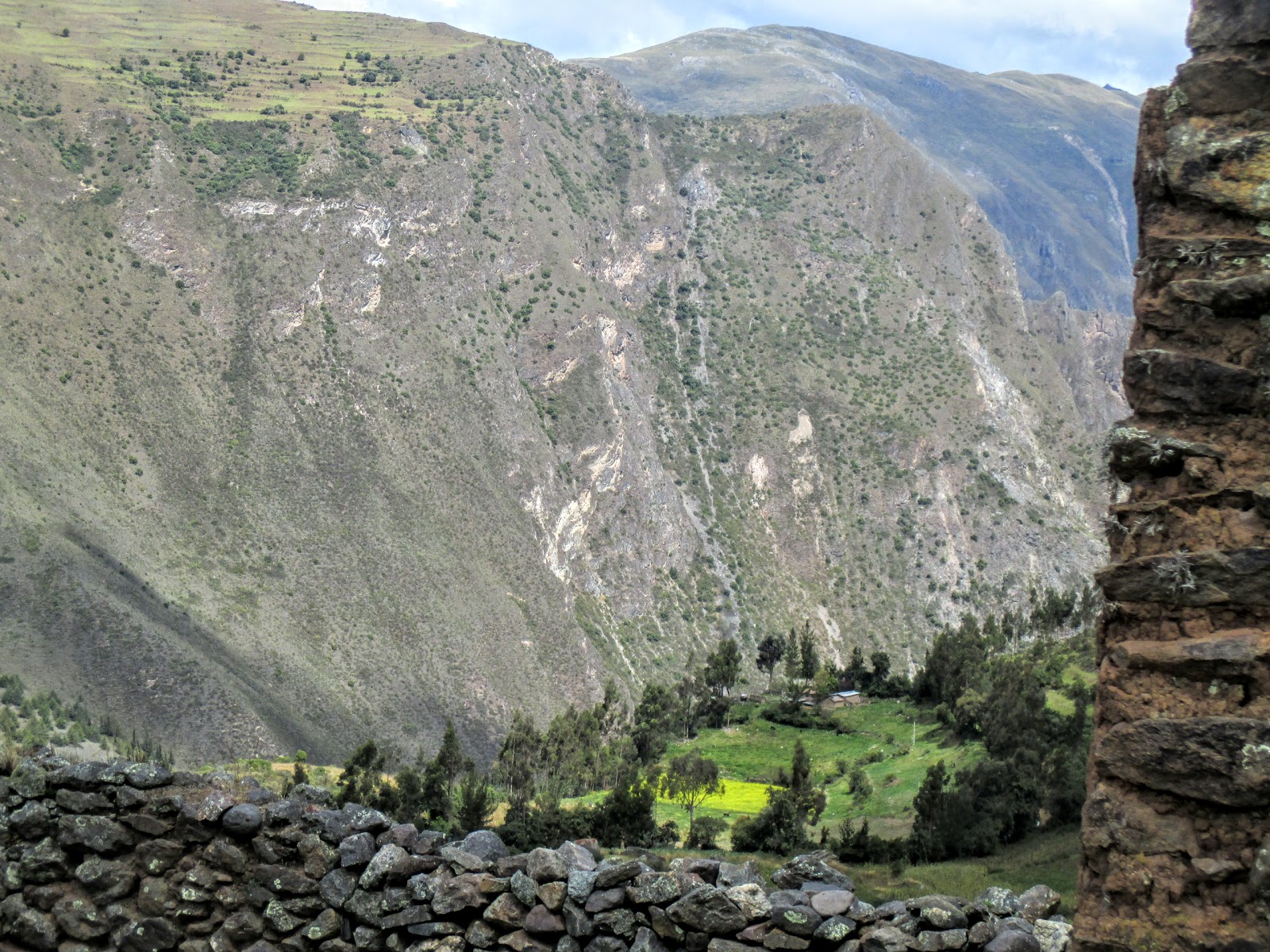
The 6 km hike up to the ruins of Pumamarca was one of my favorite walks. A short way out of Ollantaytambo we passed the restored Media Luna terraces.  We then began to climb, rapidly gaining altitude, with great views of the river valley below.  We followed an irrigation canal above the 100 terraces, and from the terraces it was a short climb to Pumamarca.

The Pumamarca sites provides views of routes from the Amazon, and routes into Cusco.  The entire site is surrounded by a wall.


View of the Media Luna terraces on our return to Ollantaytambo.

Sunday, July 2, 2017

Ollantaytambo, Peru


Ollantaytambo, designed by the Incas and nestled between the mountains and the Urubamba River, was clearly my favorite spot of our Peru visit. Some of the gems I enjoyed while in Ollantaytambo include: 

  • The architectural features of this small city inhabited since the mid-fourteenth century 
Irrigation canals with bubbling water

The fine stonework and double-jamb entrance indicate an Inca of high importance


Narrow cross streets paved with cobblestone


  • Easy access to terraced cropland and farmers working the land with no mechanization 
A small plot of quinoa in the foreground, a traditional crop of the Andes

Terraces with amaranth and corn, two crops grown by the Incas


Cutting oats with a sickle


  • The ever changing spectacular views afforded by hiking outside of town


I will add information about additional pre-Inca and Inca sites around Ollantaytambo in a future blog.